"AI won't replace ERP professionals. But ERP professionals who leverage AI copilots like Joule will replace those who don't."
Every software vendor is talking about AI. Every conference features AI keynotes. Every CIO is being asked about their AI strategy. But beneath the hype, something genuinely transformative is happening in enterprise software. SAP Joule isn't just another chatbot slapped onto an ERP system—it's a fundamental reimagining of how humans interact with enterprise applications. And after analyzing the latest 2026 capabilities, I believe we're witnessing the emergence of what could become the most comprehensive enterprise AI copilot in the market.
The Operating System for Enterprise Work
When SAP first announced Joule, skepticism was warranted. We've seen countless "AI-powered" features that amounted to little more than keyword search with extra steps. But what SAP has built is different in a fundamental way: Joule isn't a layer on top of SAP systems—it's woven into the fabric of the applications themselves.
The numbers tell a compelling story. By early 2026, SAP has embedded over 400 AI-driven use cases across their application portfolio. Joule encompasses 2,100+ AI skills that cover approximately 80% of core SAP functionality. Early adopters are reporting 80% faster completion of routine tasks. But these statistics, impressive as they are, miss the real point.
What matters isn't speed—it's the shift in how work happens. Joule doesn't just accelerate existing processes; it fundamentally changes the interaction model between humans and enterprise systems. Instead of navigating through complex menu hierarchies and transaction codes, users converse with their systems in natural language. Instead of manually correlating data across modules, Joule synthesizes information on demand. Instead of reactive responses to problems, Joule proactively surfaces insights and recommends actions.
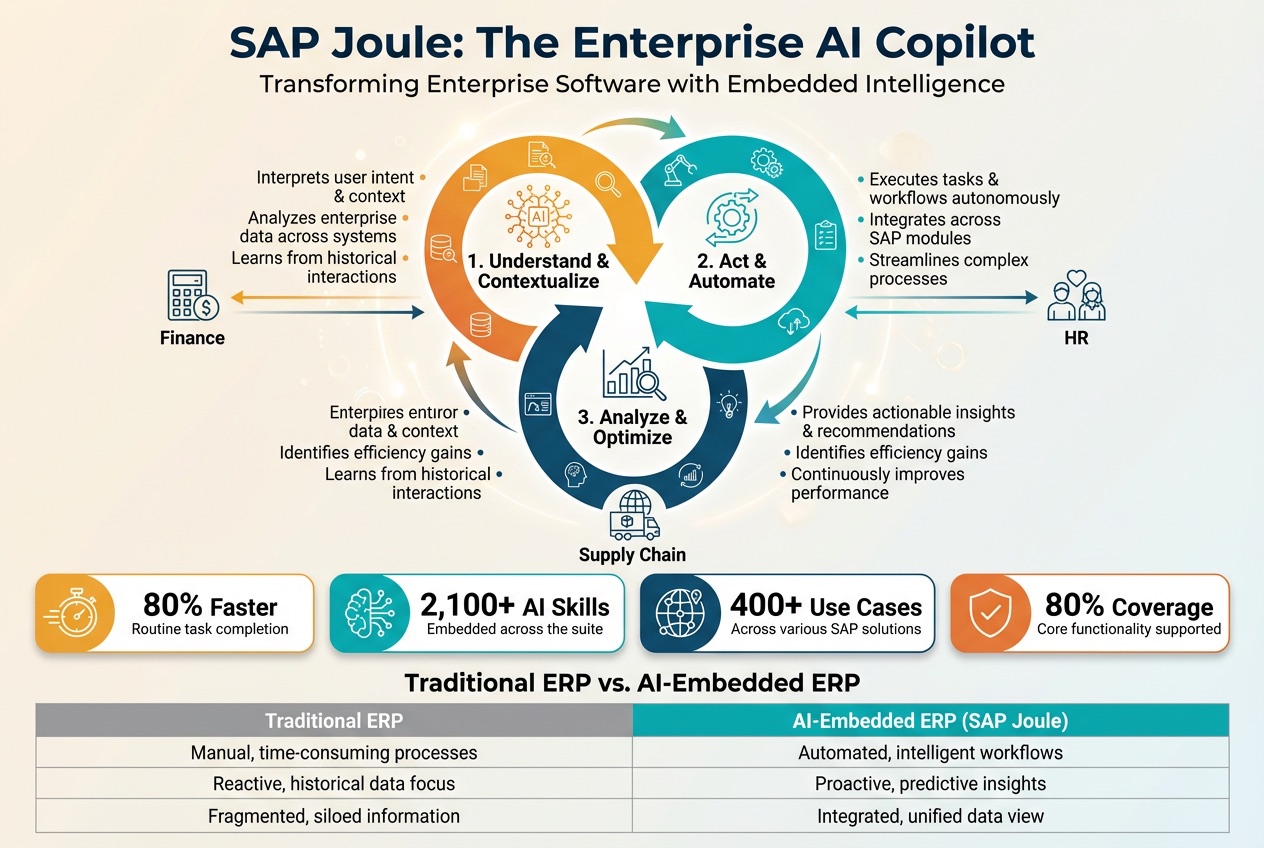
Beyond Chatbots: The Perception-Reasoning-Action Loop
Understanding what makes Joule different requires understanding how agentic AI systems work. Unlike generative AI models that simply create content in response to prompts, agentic AI systems operate through continuous perception-reasoning-action (PRA) loops.
Perception: Joule continuously ingests data from across your SAP landscape—S/4HANA, SuccessFactors, Ariba, Concur, and more. It processes structured transaction data, semi-structured documents, and unstructured communications. Through the SAP Knowledge Graph, it understands the relationships between entities, processes, and data points across your entire business.
Reasoning: This is where the magic happens. Joule doesn't just retrieve information; it reasons about it. When a finance manager asks about cash flow forecasts, Joule doesn't simply display a report. It analyzes payment patterns, considers seasonal trends, factors in outstanding receivables, evaluates supplier payment terms, and synthesizes a contextual forecast with confidence intervals. The reasoning engine uses large language models enhanced with domain-specific fine-tuning on SAP business processes.
Action: Joule can execute. It doesn't just suggest that you might want to adjust a procurement schedule—it can draft the change, route it for approval, and execute it once authorized. It can create journal entries, initiate workflows, update master data, and orchestrate complex multi-step processes. All with appropriate role-based permissions and audit trails.
Real-World Applications: Where Joule Delivers Value Today
The practical applications of Joule span virtually every enterprise function. Let's examine how organizations are actually using it:
Finance and Accounting: The Dispute Resolution Agent exemplifies Joule's capabilities. When invoice discrepancies arise, the agent automatically analyzes the invoice against the purchase order and delivery documentation, identifies the root cause of the mismatch, flags the discrepancy for relevant parties, generates credit memos when appropriate, and even automates accruals and reconciliations. What used to take finance teams days of manual investigation now happens in minutes.
Cash flow forecasting has been transformed. Joule ingests historical payment data, analyzes customer payment behaviors, considers macroeconomic indicators, evaluates seasonal patterns, and produces rolling forecasts with scenario analysis. CFOs report that Joule's forecasts are consistently more accurate than traditional statistical models because they can incorporate hundreds of variables that humans couldn't practically track.
Supply Chain and Procurement: The Sourcing Agent demonstrates autonomous procurement intelligence. It continuously monitors purchasing patterns, identifies sourcing opportunities, evaluates supplier performance and pricing, initiates RFP processes, and even handles routine vendor communications. For supply chain disruptions, Joule can detect potential bottlenecks before they occur, simulate alternative scenarios, recommend mitigation strategies, and execute approved changes.
In manufacturing environments, Joule optimizes production schedules by balancing demand forecasts with capacity constraints, material availability with lead times, quality requirements with cost optimization, and customer priority with production efficiency.
Human Resources: In SuccessFactors, Joule has become an invaluable recruitment and development tool. It generates job descriptions optimized for target candidates, creates competency-based interview questions, analyzes candidate responses against role requirements, and recommends personalized learning paths based on skills gaps and career aspirations. HR teams report that Joule reduces time-to-hire while improving candidate quality.
Employee engagement is enhanced through Joule's ability to analyze sentiment in survey responses, identify concerning patterns or trends, recommend targeted interventions, and even draft personalized communications for managers.
Joule Studio: The Game-Changer for 2026
The launch of Joule Studio in Q1 2026 represents a pivotal moment. Previously, organizations were limited to the AI capabilities that SAP built into their applications. With Joule Studio, any organization can now build custom AI agents tailored to their specific business processes.
The development model is remarkably accessible. Using low-code/no-code tools within SAP Build, business analysts—not just developers—can create sophisticated AI agents. The process is intuitive:
- Define the agent's purpose in natural language. For example: "Create an agent that validates maintenance orders against current material stock levels and flags potential fulfillment issues."
- Connect to data sources using pre-built connectors to SAP systems and third-party applications.
- Configure reasoning logic by specifying the rules, policies, and decision criteria the agent should follow.
- Add tools and skills that the agent can use to take actions—calling APIs, updating records, generating documents.
- Test and refine in a sandbox environment before deploying to production.
The implications are profound. Organizations can now create AI agents for their unique processes—industry-specific workflows that no vendor would build, company-specific policies that require custom logic, integration scenarios that bridge legacy and modern systems, and compliance requirements that demand specialized handling.
One manufacturing client created a custom agent that coordinates between their SAP S/4HANA system and their MES (Manufacturing Execution System). When production orders are released, the agent validates material availability, checks equipment maintenance schedules, verifies operator certifications, and even considers energy costs to optimize production timing. This level of orchestration would have required months of custom development. With Joule Studio, they built and deployed it in three weeks.
Key Insight
Joule Studio shifts the question from "What can AI do for my business?" to "What business problems can I solve by building AI agents?" The constraint is no longer technology—it's imagination and clear process definition.
The Architecture That Enables It All
Joule's capabilities rest on four architectural pillars:
SAP Business Technology Platform (BTP): Provides the runtime environment, integration fabric, and AI services. Joule agents run as containerized services with elastic scaling, ensuring performance even during peak usage.
SAP Build Work Zone: Delivers the unified user experience across SAP and non-SAP applications. Users interact with Joule through a consistent interface regardless of which backend systems are involved.
SAP Cloud Identity Services: Handles authentication, authorization, and security. Every Joule interaction respects role-based permissions and maintains complete audit trails. When Joule acts on your behalf, it does so with your credentials and within your authorization scope.
SAP Knowledge Graph: This is perhaps the most underappreciated component. The Knowledge Graph represents your business as a semantic network—products, customers, suppliers, transactions, and their relationships. This enables Joule to reason about your business context, not just retrieve data points.
The Implementation Reality: What You Need to Know
Having worked on SAP implementations for over a decade, I know that architectural elegance means little if implementation is painful. So what's the reality of deploying Joule?
The good news: If you're on S/4HANA Cloud or SuccessFactors, Joule capabilities are already there. Activation is often just a matter of configuration and user enablement. The native integration means no complex middleware, no data replication, and no synchronization headaches.
The challenge: Joule's effectiveness depends entirely on your data quality and process clarity. An AI agent trained on inconsistent master data will produce inconsistent results. An agent operating in environments with poorly defined processes will struggle to provide value. This isn't a Joule limitation—it's a fundamental characteristic of AI systems.
For organizations still on ECC or older versions of Business Suite, extending Joule to on-premise systems is possible but requires more infrastructure work. You'll need SAP Cloud Connector for secure connectivity, BTP destinations configured properly, and potentially some API exposure layer if your custom code lacks modern interfaces.
Security and governance warrant special attention. While Joule respects SAP authorizations, you need to think carefully about what autonomous actions to allow. Implementing human-in-the-loop checkpoints for high-value transactions, establishing clear audit trails for AI-driven decisions, defining escalation procedures for edge cases, and creating monitoring dashboards to track agent performance are all essential.
The Competitive Landscape: How Joule Compares
Every major enterprise software vendor is racing to embed AI. Microsoft has Copilot for Dynamics. Oracle has Generative AI for Fusion. Salesforce has Einstein GPT. Workday has Workday AI. How does Joule stack up?
Joule's key advantage is depth of integration. SAP controls the entire stack—the applications, the platform, the data model, and now the AI layer. This enables capabilities that would be extremely difficult for competitors to replicate. When Joule reasons about a financial close process, it has native access to every table, every transaction, every workflow state. It doesn't rely on API calls or data synchronization.
The SAP Knowledge Graph is another differentiator. While other vendors are building knowledge graphs, SAP has decades of business process expertise encoded into theirs. The graph understands that a sales order relates to a delivery relates to an invoice relates to a payment—and all the business rules that govern those relationships.
Where Joule currently lags is in the breadth of integrations with non-SAP systems. Microsoft Copilot benefits from Microsoft's ecosystem dominance. Salesforce Einstein can tap into the extensive AppExchange. SAP is playing catch-up here, though Joule Studio's extensibility helps bridge this gap.
Looking Ahead: The Autonomous Enterprise
SAP speaks of "Autonomous ERP 2026"—systems that don't just respond to user requests but proactively manage processes end-to-end. We're not there yet, but the trajectory is clear.
Imagine an accounts payable process where Joule automatically validates invoices against purchase orders, routes exceptions for human review, negotiates payment terms with suppliers (within defined parameters), optimizes payment timing for cash flow and discounts, and learns from each transaction to improve future decisions. The human role shifts from data entry and validation to exception handling and strategic decisions.
Or consider supply chain management where Joule continuously monitors demand signals, evaluates supplier capacity and lead times, simulates scenarios for potential disruptions, proactively adjusts procurement and production plans, and coordinates across procurement, manufacturing, and logistics—all while keeping humans informed and in control.
These aren't far-future scenarios. The underlying capabilities exist today. What's evolving is organizational readiness to trust AI systems with increasingly consequential decisions.
Getting Started: A Practical Roadmap
If your organization is considering Joule, here's a pragmatic approach:
1. Assess your foundation. Before enabling any AI capabilities, evaluate your data quality, process documentation, and authorization concepts. AI amplifies what you have—if your foundation is weak, AI will amplify the weaknesses.
2. Start with information retrieval. The lowest-risk, highest-value starting point is using Joule for information access. Let users ask questions and get answers. This builds familiarity and trust without any process risk. Common starting points include financial reporting inquiries, employee data lookups, supply chain status checks, and customer account information.
3. Progress to recommendations. Once users are comfortable with information retrieval, enable recommendation features. Joule suggests but doesn't execute. Users see the value while maintaining control. Examples include procurement sourcing suggestions, cash flow optimization recommendations, candidate ranking in recruitment, and inventory reorder prompts.
4. Enable supervised actions. Gradually allow Joule to take actions that require human approval. This builds confidence in the AI's decision-making while maintaining governance. Start with low-risk actions like updating address information, routine status changes, standard report generation, and data cleansing tasks.
5. Scale to autonomous operations. Only after demonstrating value and building organizational confidence, enable autonomous actions within well-defined boundaries. This requires robust monitoring, clear escalation paths, and continuous refinement.
6. Develop custom agents. As your organization becomes proficient with standard Joule capabilities, leverage Joule Studio to address your unique processes and requirements.
Critical Success Factor
The organizations seeing the most value from Joule aren't those with the most advanced AI strategies—they're those with the clearest processes and highest data quality. AI amplifies your operational excellence; it doesn't create it.
The Question Isn't "If" But "How"
AI in enterprise software has reached an inflection point. We've moved past proof-of-concepts and pilot projects. The technology works. The use cases are proven. The value is demonstrable.
The question facing organizations today isn't whether AI will transform how we work with enterprise systems. That transformation is already underway. The question is whether your organization will shape that transformation or simply react to it.
SAP Joule represents the most comprehensive attempt yet to embed AI throughout an enterprise software portfolio. It's not perfect—no first-generation technology is. But it's real, it's capable, and it's improving rapidly.
For SAP customers, the imperative is clear: understand what Joule can do, evaluate where it fits your needs, and start building organizational competence with AI-augmented processes. The learning curve exists whether you start today or next year. Starting today gives you the advantage of experience.
For the broader market, Joule sets a benchmark. This is what enterprise AI looks like when it's deeply integrated rather than superficially applied. Other vendors will need to match or exceed this level of integration to compete effectively.
We're witnessing the emergence of a new category: the AI operating system for enterprise work. Joule is SAP's bid to own that category. Whether they succeed depends not just on technology but on how effectively they can help organizations navigate the cultural, operational, and strategic challenges of working alongside AI agents.
The future of enterprise software isn't humans replaced by AI. It's humans and AI working in concert—AI handling the repetitive, the analytical, and the process-driven work, while humans focus on the strategic, the creative, and the exceptional. SAP Joule is showing us what that future looks like. The question is: are you ready to work there?